
Prompts
Use predefined prompt templates from MCP servers in your application
Prompts allow MCP servers to expose reusable prompt templates that can be easily inserted into your application. This enables standardized workflows, consistent prompt patterns, and quick access to commonly used prompts provided by MCP servers.
For more details on the prompts specification, see the MCP Prompts documentation.
What are Prompts?
Prompts are predefined text templates exposed by MCP servers that users can insert into their message input. This is useful when:
- An MCP server provides helpful prompt templates for common tasks
- You want to standardize how users interact with specific tools or workflows
- Users need quick access to complex prompts without memorizing syntax
For example, a GitHub MCP server might provide prompts like "Create a detailed issue report" or "Review this pull request", which expand into well-structured templates when selected.
User Experience
Using the "/" Hotkey
Type "/" at the start of an empty text field to quickly access prompts:
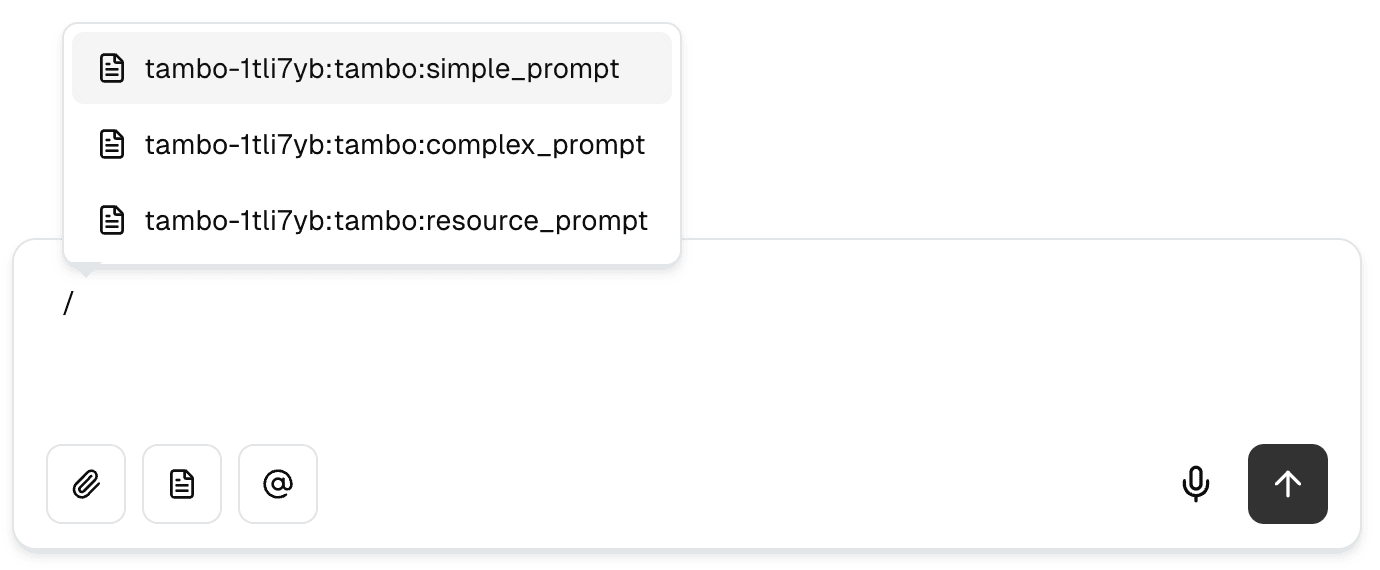
- Type "/" at the beginning of an empty message input
- A dropdown appears showing all available prompts
- Type to filter prompts by name
- Use arrow keys to navigate and Enter to select
- The selected prompt text is inserted into the message input
Using the Prompts Button
Alternatively, click the prompts button to browse available templates:
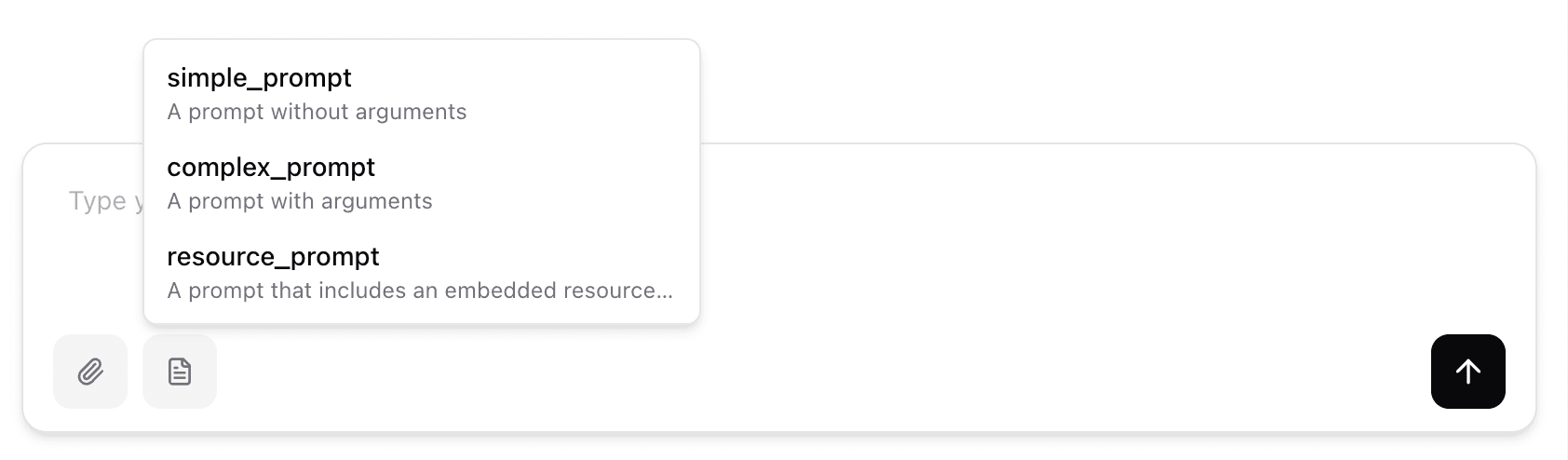
- A document icon (📄) appears in the message input area
- Clicking it opens a dropdown showing all available prompts
- Prompts are organized by MCP server
- Selecting a prompt inserts its content into the message input
- The user can then edit the prompt before sending
Prompt Naming
Prompts are always prefixed with the serverKey to identify which MCP server they come from. The format is:
<serverKey>:<promptName>For example, a prompt called new-issue from a Linear MCP server with serverKey of linear would be referenced as linear:new-issue.
The serverKey is configured when setting up the MCP server:
- Client-side: Set in the
mcpServersarray passed toTamboProvider - Server-side: Configured in your Tambo Cloud project settings
If you don't specify serverKey, Tambo derives one from the URL (e.g., https://mcp.linear.app/mcp becomes linear). For more details, see Server namespacing.
Built-in Support
The message-input component automatically displays available prompts from all connected MCP servers. When any MCP server exposes prompts, a document button (📄) appears in the message input area:
import { MessageInput } from "@/components/ui/message-input";

// Prompts are automatically displayed - no additional setup needed
<MessageInput>
  <MessageInput.Textarea />
  <MessageInput.McpPromptButton />
  <MessageInput.SubmitButton />
</MessageInput>;
The prompt picker automatically:
- Discovers prompts from all connected MCP servers
- Displays them in a dropdown menu
- Inserts the selected prompt into the message input
- Only appears when at least one MCP server has prompts available
How It Works
Here's the typical flow when a user selects an MCP prompt:
Current Limitations
Parameters are not yet supported. While the MCP specification allows prompts to accept parameters for customization, Tambo's current implementation does not expose parameter input fields. All prompts are inserted as-is without user customization.
This means:
- Prompts with parameters will use their default values
- Users cannot customize prompt templates at insertion time
- Parameter support is planned for a future release
Programmatic Access
You can access Prompts programmatically using the provided hooks:
List All Prompts
Use useTamboMcpPromptList to get all available prompts from connected servers:
import { useTamboMcpPromptList } from "@tambo-ai/react/mcp";

function PromptList() {
  const { data: prompts, isLoading, error } = useTamboMcpPromptList();

  if (isLoading) return <div>Loading prompts...</div>;
  if (error) return <div>Error loading prompts</div>;

  return (
    <ul>
      {prompts?.map((entry) => (
        <li key={`${entry.server.url}-${entry.prompt.name}`}>
          <strong>{entry.prompt.name}</strong>
          <p>{entry.prompt.description}</p>
          <small>From: {entry.server.name}</small>
        </li>
      ))}
    </ul>
  );
}
The hook returns an array of ListPromptEntry objects, each containing:
server- The connected MCP server providing this promptprompt- The prompt metadata (name, description)
Note: The prompt.name field will include the serverKey prefix (e.g., linear:new-issue).
Get Specific Prompt
Use useTamboMcpPrompt to fetch a specific prompt's content:
import { useTamboMcpPrompt } from "@tambo-ai/react/mcp";

function PromptContent({ promptName }: { promptName: string }) {
  // promptName should include the serverKey prefix (e.g., "linear:new-issue")
  const { data: prompt, isLoading, error } = useTamboMcpPrompt(promptName);

  if (isLoading) return <div>Loading...</div>;
  if (error) return <div>Error loading prompt</div>;
  if (!prompt) return null;

  return (
    <div>
      <h3>{prompt.description}</h3>
      {prompt.messages.map((msg, idx) => (
        <div key={idx}>
          <strong>{msg.role}:</strong>
          {msg.content.type === "text" && <p>{msg.content.text}</p>}
        </div>
      ))}
    </div>
  );
}
The hook accepts:
promptName- The name of the prompt to fetchargs- Optional parameters (currently not exposed in UI)
Connection Type Support
Prompts work with both connection types:
- Server-side MCP - ✅ Fully supported
- Client-side MCP - ✅ Fully supported
Both connection types can expose prompts that will appear in the prompt picker.
Example Use Cases
Documentation Templates
A documentation MCP server provides prompts for common documentation patterns:
- "API endpoint documentation"
- "Component usage guide"
- "Troubleshooting section"
Code Review Prompts
A code review MCP server offers structured review templates:
- "Security-focused code review"
- "Performance optimization review"
- "Accessibility audit"
Task Management
A task tracking MCP server provides prompts for common workflows:
- "Create bug report"
- "Plan feature implementation"
- "Write release notes"
Future Capabilities
Planned enhancements for MCP prompts include:
- Parameter support: Allow users to customize prompts with dynamic values
- Custom UI: Build custom prompt pickers with different layouts
- Prompt history: Track frequently used prompts